Administrator Video
Josh Reese is a district administrator who served as a supervisor in the Project RAISE program.
General Information
What Districts Need to Know
Sample Interview Questions
Tier 1 Questions
- What influenced you to be a school counselor?
- What’s the school counselor’s role in promoting equity and access for all students?
- When considering school counseling ethical standards and school policies, how would you handle a conflict between the two?
- What do you like about working with (grade level) school students? Describe how your specific skills/interests will help you connect to this student population.
- How do you handle criticism?
- How do you handle stress?
- What has your experience been in working with students of color? LGBTQ students?
- What is the counseling theory or approach that you most closely follow?
- What is your school counseling philosophy?
- How does school data inform the school counseling program?
- How does a school counseling program support school counselor advocacy?
- How would you address an irate parent?
- How do you manage conflict and create solutions with stakeholders?
- What would you do…
- You suspect one of your students is being abused?
- One of your students talks to you about wanting to kill himself/herself?
Tier 2 Questions
- How will the school counseling program facilitate a more peaceful/safe school environment?
- How do the ASCA student standards (Mindsets & Behaviors) inform the work of the school counselor?
- What do you consider the most important reason(s) for you, personally, to become a member of this faculty?
- What experiences have you had in working with special education students?
- How do you keep yourself organized?
- Where do you see yourself in the next five years?
- How does the ASCA National Model support all students?
- How do you develop a positive relationship with students in individual counseling? Small-group counseling? What’s the role of a school counselor to student relationship in individual and group counseling?
- What technology applications do you see being useful in your work?
- What is your view on collaborative consultation in the schools?
- How would you address cultural differences in a school setting?
- How will the school counseling program facilitate a more peaceful/safe school environment?
- What is the school counselor’s role in relation to teachers, parents, administrators and other school counselors?
- What do you think is the most important characteristic of a school counselor? What’s the most essential characteristic school counselors have that supports a caring/supportive school climate for all students?
Tier 3 Questions
- What do you see as the most effective use of a school counselor’s time?
- How would you approach appraisal and advisement?
- What type of activities would you deliver in a school counseling program to address an achievement gap, opportunity gap or attainment gap?
- What innovative and new ideas would you like to employ as a school counselor?
- How do you see the word “leader” fitting into your role as a school counselor? How do school counselors model leadership? How is leadership a part of the school counselor’s role? In schools, where can school counselors be leaders?
- Describe a time when you provided leadership around a specific need/issue/situation?
- How do school counselors advocate for students differently than other school staff?
- How do school counselors advocate for systemic change?
- How would you address a passive or uninvolved parent?
Intern Orientation
One of the most significant advantages of hiring interns is the opportunity to select and develop your future talent. With good exposure to the setting, many interns may want to become a colleague and a full time hire the following year. Interns will need to learn about the setting, position and interact with staff members to make this happen. This can be accomplished through Internship Onboarding or Internship Orientation. Some aspects of this can occur virtually and others are best done in person.
An internship orientation is a series of onboarding activities, training sessions, and team meetings that are designed to introduce a new intern to the settings values, the internship role, and the settings/policies.
Internship onboarding is a good way to introduce your new interns to the primary activities of your role in the school setting. It is very important for interns to be warmly welcomed into your organization. The sooner your intern understands your roles and duties, the sooner they can assume assigned responsibilities and work efficiently.
Expectations vary based on the size of your school and setting, but here are a few things to review with your new interns:
Designing a thorough onboarding and training plan will help interns learn quickly and become a productive member of your team. Investing supervisory time with your interns can set the tone for the program and the internship experience. Taking some time to set up virtual team meetings or one-on-ones can help your interns feel more connected to the team and allow them to feel comfortable reaching out when they need help. But make sure you have an internship orientation checklist to go off.
What is a social worker?
Please read through our presentation that talks about the mental health risks our school districts and families face without adequate school social work support. Project RAISE is trying to fill a large gap with its paid internships due to current school counselor shortages, school psychologist shortages, and school social work shortages.
Are You Ready for an Intern?
Checklist for Accepting Interns
The document linked below is a checklist for schools interested in hosting a school social work intern, the requirements of hosting a student and the processes they need to be prepared to manage and participate in for requirement completion. This is meant to be a support document. Please note that some university programs
may have slightly different requirements than the ones described, but this list is to guide the school in determining their readiness for accepting an intern.
District Responsibilities
Links to Social Work, Counselor, and Psychologist Intern Guidelines
School Social Work Guidelines
School Counseling Guidelines
School Psychologist Guidelines
District Map
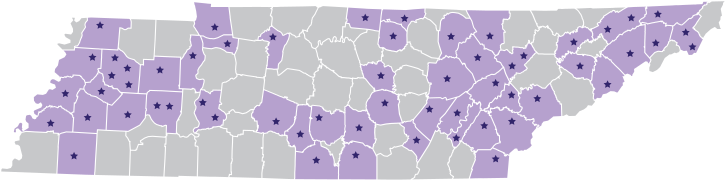
Project RAISE Districts include:
- Northwest: Benton County Schools, Bradford Special School District, Crockett County Schools, Dyer County Schools, Gibson County Special School District, Humboldt City School District, Milan Special School District, Obion County School District, South Carroll Special School District
- Southwest / Memphis: Fayette County Public Schools, Haywood County Schools, Henderson County Schools, Jackson-Madison County School District, Lauderdale County School District, Lexington City Schools, Tipton County Schools
- South Central: Bedford County Schools, Coffee County School District*, Franklin County School District, Lawrence County School System*, Lincoln County Schools, Marshall County School System, Maury County Public Schools, Perry County Schools
- Mid Cumberland: Cheatham County School District, Houston County School District, Stewart County School System
- Upper Cumberland: Bledsoe County Schools, Clay County Schools, Cumberland County School District, DeKalb County School District*, Fentress County Schools, Jackson County School District*, Macon County Schools, Warren County Schools
- Southeast: McMinn County Schools, Meigs County Schools, Polk County Schools, Rhea County School District, Sequatchie County Schools
- East: Anderson County Schools, Blount County Schools, Clinton City Schools*, Grainger County School District, Jefferson County Schools, Loudon County Schools, Morgan County School District, Monroe County Schools, Roane County School District, Scott County Schools
- First: Carter County Schools, Cocke County School District, Elizabethton City Schools, Greene County Schools, Hawkins County School District, Rogersville City Schools, Sullivan County Schools, Washington County Schools
*New districts for the 2025 – 26 school year.
- Districts no longer available beginning Fall 2025: Bells City, Giles County, Hancock County, Lewis County, Sevier County
FAQs
My school district has been designated as a Project RAISE district. What does that mean for our district, schools, and students?
You have been identified as a Project RAISE affiliated school districts based on the following criteria:
- Your school district has been identified as a rural (i.e., small or sparse weight) Tennessee public school district.
- District administrator(s) have indicated employment vacancies and/or dependence on contract employees for school counselors, school psychologists, and/or school social workers.
- Your district has indicated an interest in partnering with Project RAISE to fill vacancies and/or reduce the need for contract services.
This means we will work together with you to recruit AND retain school counseling, school psychologist, and school social work interns to/in your district to increase access to much needed supports and services for students, teachers, and families in the district.
If the goal of Project RAISE is to recruit and retain school-based mental health interns in affiliated districts, does that mean that interns will automatically be placed in our district?
Project RAISE does not participate in the actual placement of an intern into your school. We are diligently working with universities and professional organizations to spread awareness about our project to future school-based mental health interns across the country to encourage them to select a Project RAISE affiliated school for their internship. A list of affiliated school districts is available on our website, but the intern follows their university’s process to identify, select, or place interns. in these positions.
We encourage you to take necessary steps to communicate available internship positions within your district. These steps may include:
- Creating and posting a position online.
- Contacting university programs in the appropriate field(s) of study where you are looking to fill vacancies.
- Promoting position(s) at university job fair(s).
- Connecting with students and university educators at state/national conferences held by professional organizations.
Be sure to state that your district is a Project RAISE affiliated district in your recruitment efforts and include the Project RAISE website.
We have a student who wants to intern in our district as a part of Project RAISE. What steps should we take to make this happen?
This is great news! You should take appropriate steps to vet the student’s qualifications, eligibility, and fit for the internship position. Although the internship opportunity does not guarantee eventual employment, a permanent position post-internship is a goal of Project RAISE, so you are encouraged to give full consideration of each applicant, similar to the hiring process, to provide the best fit for a job offer at the end of a successful internship experience.
Be sure to follow the applicable district, state department of education, and/or university program policies and procedures to complete relevant background checks and sign needed contracts or agreements prior to the start of the internship.You will also need to identify/assign a field-based/site supervisor. Keep in mind that field-based/site supervisors are generally required to hold the appropriate licensure/certification to practice in the intern’s field of study and that each field has specific standards to meet university program and/or licensure requirements. If you need assistance in this process, please contact our team at projectraise@utk.edu.
To learn more about licensure requirements, please refer to the Tennessee Department of Education’s guidance or email educator.licensure@tn.gov.
When will the intern start and what work are they required/expected to do in this experience?
Great question, but you’ll need to check with the intern and/or their university program contact for these details since we do not set or define any standards or requirements for the intern’s practice. All interns are expected to comply with the standards and requirements set by their university programs since these are typically aligned with degree and eventual licensure requirements. Interns are also expected to comply with school district policies and requirements–please be sure that you communicate relevant information to the intern in a timely manner.
To learn more about licensure requirements, please refer to the Tennessee Department of Education’s guidance or email educator.licensure@tn.gov.
What are the benefits and requirements of Project RAISE interns?
Project RAISE interns will receive a monthly stipend for their internship experience (the total amount is dependent on the intern’s field of practice considering the number of hours/time in the school setting varies greatly among professions); they are also eligible to receive an additional $1200 stipend for relocation or travel (i.e., commuting) costs.
Other benefits include:
- One-year membership to the state association in the appropriate field of practice
- Registration fees paid to attend the state association’s annual conference during the internship year.
- Access to state-level leadership and experts in the field.
In exchange for these benefits, Project RAISE interns are required to:
Attend available sessions in our Professional Development Series.
Commit to provide school-based mental health services as a Tennessee public school district employee for two years after the internship experience; they must be employed in a rural/Project RAISE for at least one of the two years.
Participate in monthly Community of Practice meetings, facilitated by a project partner, with fellow Project RAISE participants across the state.
Our Project RAISE intern was removed or resigned from their internship (or we were recently notified by the university program that they were removed from their degree program). What happens next considering their participation in Project RAISE?
The school district and/or the university program are required to notify us immediately if the intern is removed from their internship and/or degree program (email April Ebbinger at April.Ebbinger@tn.gov). The participant will not be required to repay stipend funds that have already been paid to that point, but they will forfeit any additional funds that might have been expected and be relieved of any associated project requirements.
Responsibilities
| Project RAISE | The Intern | The District | The University | District & University |
|---|---|---|---|---|
| Project RAISE assumes no liability and in no way replaces the standards and guideline universities and districts must follow related to graduation, licensure, and employment. | Intern interest does not guarantee they will receive Project RAISE grant funds. _________ If the university removes an intern for any reason, the intern forfeits receiving any additional funds after the removal. | The district is responsible for interviewing the intern to determine suitability. | The intern’s university is responsible for vetting the appropriateness of the internship site and ensuring the site satisfies applicable degree and licensure requirements. | The district and university are responsible for ensuring the intern has passed all applicable background checks. |
| Project RAISE only provides funds to individuals who intern in the rural districts served by the program. | Project RAISE interns agree to stay in Tennessee for at least two years post-internship, and if they leave Tennessee public schools before the two years of service are completed, they may be required to repay the grant funds received. | The intern and supervisor must attend a Project RAISE event during the summer preceding the internship experience. | The university is responsible for identifying and selecting internship supervisors. If the district needs support in identifying a supervisor, the Project RAISE leadership team can assist. | If the university removes an individual from an internship site for any reason, the intern, district and university are responsible for emailing Dr. April Ebbinger at april.ebbinger@tn.gov within 24 hours of that removal. |
| The Tennessee Department of Education (TDOE) is not responsible nor obligated to place the intern in a school district. | The intern and supervisor must attend a Project RAISE event during the summer preceding the internship experience. | If the university removes an intern for any reason, the intern forfeits receiving any additional funds after the removal. | ||
| If the university removes an individual from an internship site for any reason, the intern, district and university are responsible for emailing Dr. April Ebbinger at april.ebbinger@tn.gov within 24 hours of that removal. |